The Science
Living Behavioral Intelligence
A deterministic, mathematical objective function grounded in evolutionary optimization that models individual human psychology in real-time.

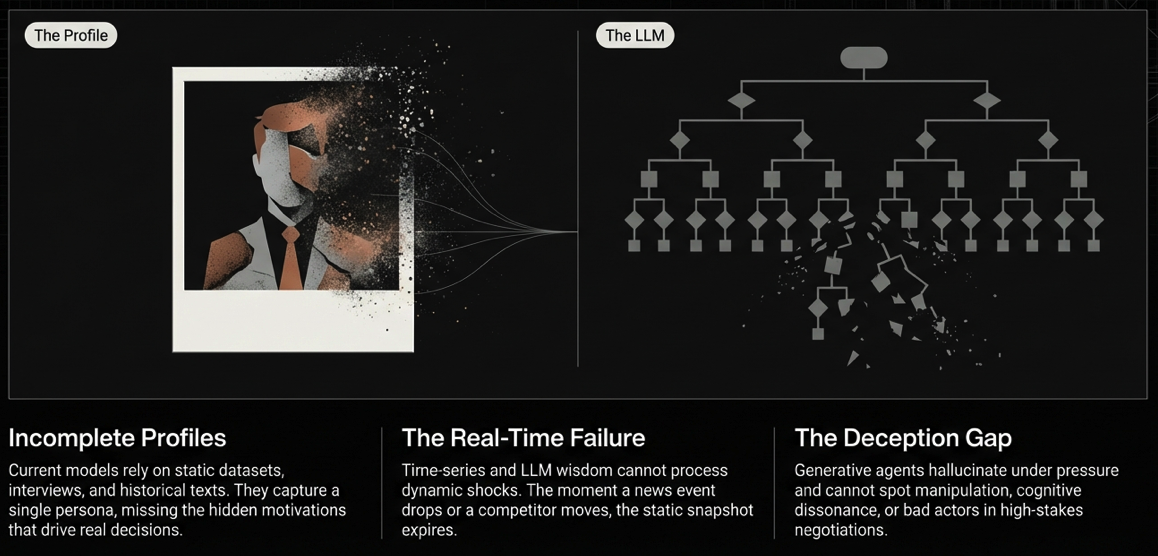
Why Current AI Fails
Three Pillars of Behavioral Failure
Every existing approach to modeling human behavior suffers from three fundamental architectural flaws.
Static Profiles
Models built on historical datasets are snapshots of average populations. They capture what groups did in the past — not what an individual will do next. By the time the data is collected, the person has already changed.
Time-Blindness
Current systems cannot adapt to real-time events — breaking news, live conversations, emotional shifts within a dialogue. They operate on stale context while the world moves forward.
Naivety
Academic models study cognition in sterile conditions, not real life. They cannot detect manipulation, strategic deception, or dishonesty — the very behaviors that matter most in high-stakes environments.
AI Structural Blindspot: Reality Happens in Realtime
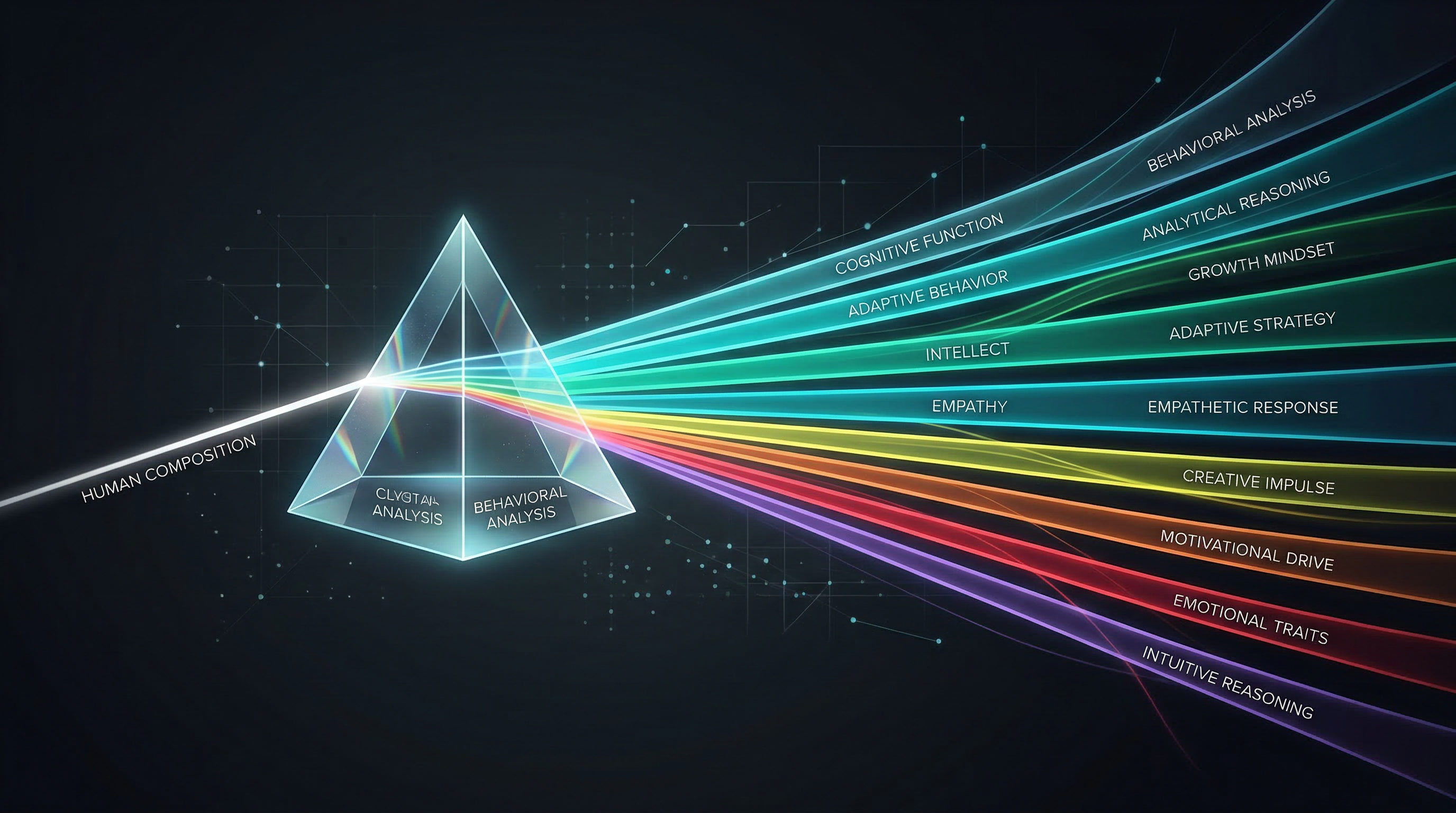
The Persona Prism
Why interviews fail
Current behavioral models rely on what people say about themselves — surveys, interviews, self-reported preferences. But people wear different masks depending on context.
In public, people present their Business Persona — cooperative, agreeable, rational. Hidden beneath are the Family Persona, the Defensive Persona, and strategic or manipulative traits that only emerge under pressure.
The Behaviour Simulator doesn't ask — it observes, infers, and decomposes each individual into their true behavioral spectrum through ambient signals and real-time interaction patterns.
Architecture
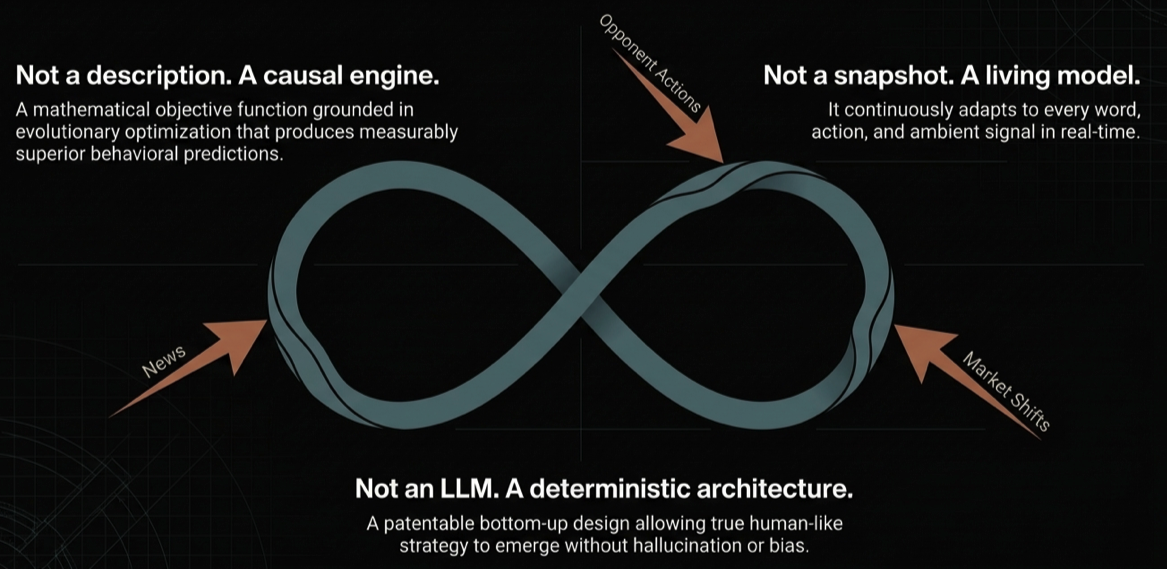
The Causal Lever Engine
Data science alone cannot include human behavior. Only a deterministic AI system can be bias-free and detect bad actors in real-time.
Input
Abstract behavioral signals: ambient data, news feeds, spoken words
Processing
Bias-free analysis + dishonesty detection + accurate actor profiling
Output
Deterministic behavioral prediction with causal explanation
Core Innovation
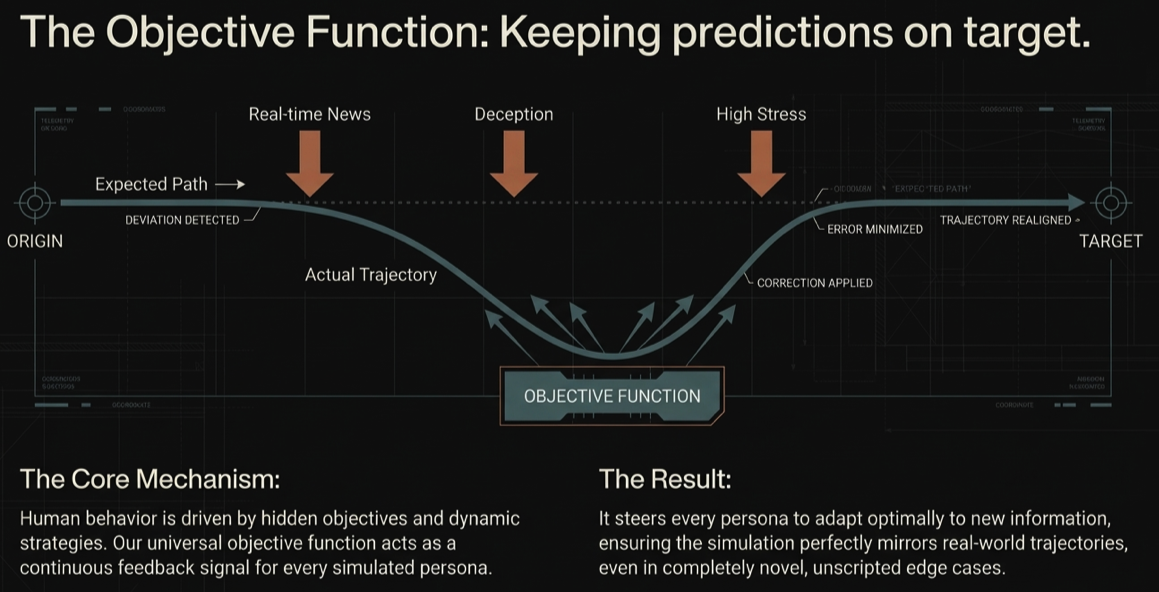
The Universal Objective Function
A patentable, bottom-up architecture that allows human-like behavior to naturally emerge and adapt optimally via the law of Evolution.
Core Engine
Universal objective function + novel profiling method
Mechanism
Reacts to every event, news cycle, spoken word to adapt each persona in real time
Outcomes
Accurate group simulations, real-time reactions, autonomous expert teams
"We haven't just built a better chatbot; we've digitized the foundational math of human motivation."
LLM vs Behaviour Simulator
The Rocket Trajectory of Conversation
Without continuous behavioral feedback, even the most powerful language models drift from reality. The Behaviour Simulator maintains trajectory.
Unguided LLM
Starts strong but quickly veers off course. Without real-time human behavioral signals, the model accumulates error with each turn. By the end of a conversation, it's addressing a statistical phantom — not the person in front of it.
Behaviour Simulator
Maintains a continuous feedback signal, readjusting to real-time human input at every step. Like a guided rocket, it self-corrects toward the real conversation outcome. Predictions stay accurate throughout entire interactions.
Competitive White Space
How we compare
The behavioral AI market is growing fast, but existing players share common architectural limitations.
| Dimension | Behaviour Simulator | Simile ($100M) | Hume AI ($74M) | Be.FM / Centaur (Academic) |
|---|---|---|---|---|
| Temporal Model | Real-time continuous compounding | Static snapshots | Session-based | Batch processing |
| Granularity | Individual-level precision | Population averages | Segment-level | Population models |
| Prediction Type | Causal & novel-situation | Descriptive / correlative | Emotion classification | Descriptive |
| Deception Detection | Built-in dishonesty patterns | Not addressed | Not addressed | Limited |
| Adaptation Speed | Every interaction turn | Model retrain cycles | End of session | Offline |